If your first takeaway from the Google Genie news was "this changes gaming, engines like Unity are dead," you're missing a large part of the story.
As a developer, I can tell you: creating a world is just a small part of the battle. We already have procedural generation, kitbashing, and plenty of tools for churning out environments. The part being missed? Iterating on the core game loop. Making it fun, balanced, and shippable. Making combat feel good. Balancing progression. Making the art beautiful and the environment cohesive to gameplay. That's where the time and money actually goes.
Genie is a world model, not a game engine replacement. And the more interesting use cases are already happening outside of gaming entirely.
Where world models actually matter
Robotics. Robots need to learn from egocentric, first-person data. Genie allows them to simulate millions of scenarios, like a robot arm grasping an object, without breaking expensive hardware in the real world. Training in simulation before deploying in reality is the whole game here, and world models make that dramatically cheaper.
Autonomous vehicles. The value for self-driving isn't a "pretty world." It's the ability to simulate edge cases, a pedestrian darting out in the rain, a construction zone with confusing signage, that are too dangerous, expensive, or time-consuming to test on actual roads.
These are the problems world models are built to solve. Generating a playable 2D platformer from a screenshot is a cool demo, but it's a demo.
What the money was actually doing
As far as Unity's stock goes, $U didn't crash because of a single AI headline. It accelerated a move that was already priced in by the big players.
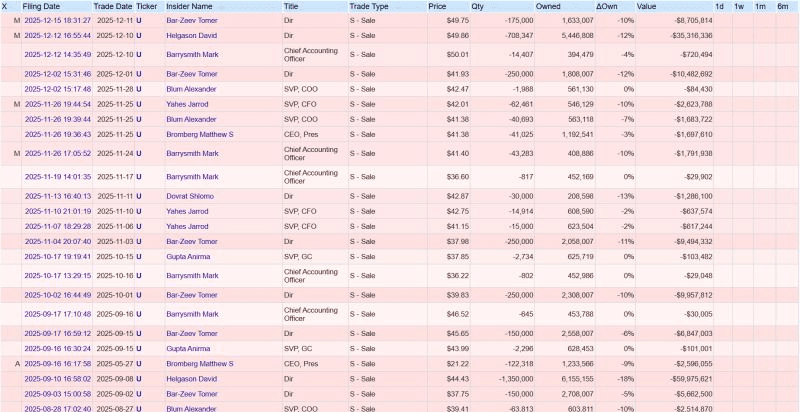
The evidence is in the insider activity. Over the last 90 days leading up to the news, executives and directors sold 1.6M+ shares, roughly $75M worth. Many of these sales happened in early December, well before the Genie news cycle.
In late December, the put/call ratio crept from 0.4 to 0.6. Big players were buying insurance while the stock was still near its 52-week highs at $52.15.
While some opened 48/50 bull call spreads in mid-January, the smart money used the January 30th news as perfect cover to unwind and reposition. Friday's options volume was 600% of the daily average. The massive new put open interest at the $25 and $30 strikes shows the market repositioning for a floor much lower than anyone anticipated in December.
On top of that, 80%+ of the outstanding shares are held by institutions: Vanguard, BlackRock, Silver Lake. This wasn't retail panic. It was institutional position management using a headline as an excuse and exit liquidity.
The actual takeaway
Will world models change the game development landscape? Probably. As the saying goes, this is the worst the technology will ever be.
Did the release of Genie kill game engines overnight? No. Not even close.
The real story here wasn't about AI at all. It was about a stock that insiders were already exiting, options flow that was already turning bearish, and a news cycle that gave institutional holders the perfect cover story. The Genie announcement was the match, but the kindling had been stacked for months.